
What Is the Best Sintered Stone in China?
Choosing the best sintered stone in China requires more than comparing showroom colors. A polished slab may look perfect under bright lights. Its real value appears during cutting, installation, and years of daily use. Kitchen heat, red wine, sharp tools, and repeated cleaning reveal weaknesses quickly. This guide examines Chinese manufacturers through measurable quality, not attractive catalog language. It considers raw materials, pressing technology, firing control, surface consistency, and technical support. Small details matter. A stable slab edge can save an installer hours on site.
A reliable evaluation should combine factory experience, technical documentation, and independent testing. Useful evidence includes batch records, thickness tolerances, water absorption results, flexural strength, and resistance testing. Certifications can support a claim, but they should never replace careful product inspection. Compare samples from different production batches. Check the reverse side, corners, printed pattern, and polished finish. Ask how the supplier handles breakage, replacement, and installation guidance. These practical questions often reveal more than a confident sales presentation.
There is no universal winner for every project. A luxury hotel may prioritize large formats and visual continuity. A family kitchen may value stain resistance, repair support, and realistic pricing. Outdoor applications require different performance considerations. Some brands communicate their strengths clearly, while others provide incomplete information. That uncertainty deserves attention. This article compares leading Chinese options with a balanced framework, recognizing both manufacturing achievements and possible limitations. The final choice should follow verified performance, application needs, and long-term supplier reliability—not marketing promises alone.
What Is Sintered Stone and How Is It Made in China?
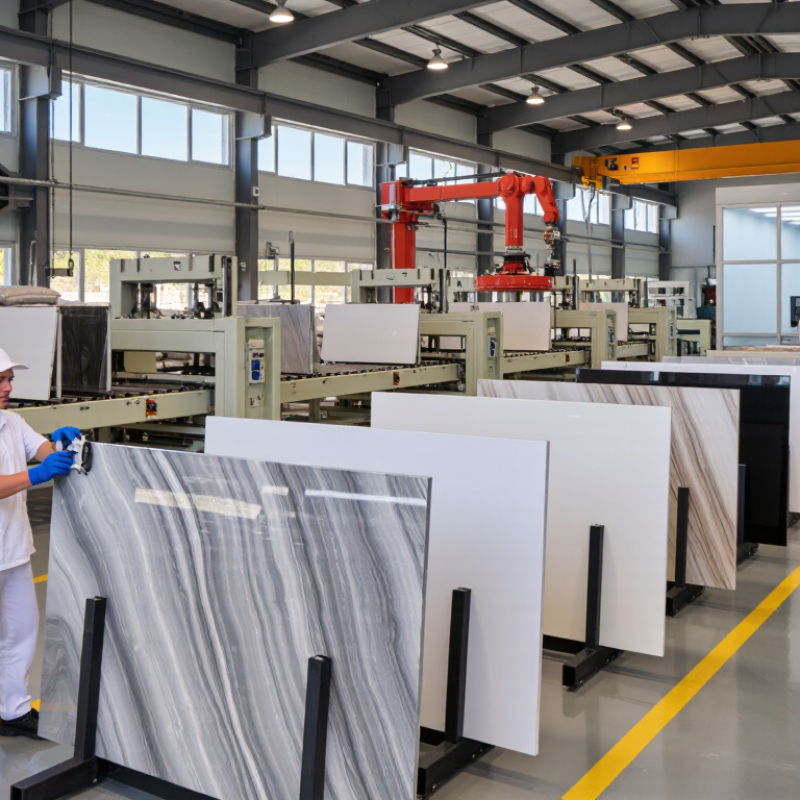
Sintered stone is an engineered slab made mainly from selected minerals, pigments, and sometimes recycled mineral content. In China, factories blend, mill, and press these materials into dense panels. Large presses remove much of the internal air. The slabs then enter kilns at temperatures commonly above 1,200°C. This heat changes the mineral structure and creates a hard, stone-like surface. The process resembles natural stone formation, but it takes hours instead of geological ages. Surface colors may come from mineral pigments or digitally applied patterns.
At a well-managed Chinese factory, production usually includes moisture control, calibrated pressing, kiln monitoring, and surface inspection. Technicians test water absorption, flexural strength, thickness, and resistance to stains or heat. These checks help buyers compare slabs beyond attractive photographs. Testing matters. Still, no production line is perfect. Slight shade differences, edge chips, or flatness problems can appear between batches. Experienced inspectors examine several slabs under consistent lighting before approving an order. Installation also affects performance, especially when cutting large panels for walls, counters, or exterior areas.
The best sintered stone in China depends on the project, not only the factory location. A kitchen may need strong stain resistance and reliable edge finishing. An outdoor application may require tested freeze-thaw performance and stable color. Buyers should request technical data, sample pieces, and batch inspection records. I would not choose the cheapest slab without checking its density and surface quality. That choice can create expensive cutting and installation problems later. Some product claims sound impressive, but independent testing remains more convincing.
| Evaluation Dimension | Typical Data or Specification | Why It Matters | Best-Suited Application | Practical Selection Guidance |
|---|---|---|---|---|
| Raw Material Composition | Refined natural minerals, including feldspar, silica, kaolin and other ceramic minerals; pigments may be added for color and veining. | A controlled mineral composition supports consistent color, density and mechanical performance. | Residential and commercial interior surfaces | Choose products with uniform slabs, stable color and complete technical documentation. |
| Manufacturing Process | Minerals are milled, mixed, pressed under high pressure, dried, digitally decorated when required, and fired at approximately 1,200–1,250°C. | High-pressure forming and high-temperature firing create a dense, low-porosity surface. | Projects requiring durable, low-maintenance surfaces | Confirm that the material is fully vitrified rather than only surface-coated. |
| Common Thicknesses | Approximately 3–6 mm for lightweight wall panels; 10–12 mm for countertops and furniture; 15–20 mm for heavy-duty or thicker applications. | Thickness affects weight, stiffness, edge strength, fabrication method and installation requirements. | Walls, countertops, vanities, tables and façades | Select thickness according to span, support structure, cut-outs and handling conditions. |
| Water Absorption | High-quality sintered ceramic surfaces typically achieve water absorption at or below 0.5%; exact results depend on the product standard and test method. | Low absorption helps resist staining, moisture penetration and freeze-thaw damage. | Kitchens, bathrooms, flooring and exterior areas | Request a laboratory test report for the exact slab series and production batch. |
| Surface Hardness | Typically around 6–7 on the Mohs mineral hardness scale, although the result varies with formulation and finish. | A hard surface provides good resistance to everyday scratching and abrasion. | Countertops, floors, public interiors and retail spaces | Use cutting boards and avoid dragging abrasive materials across polished finishes. |
| Heat Resistance | Non-combustible ceramic material with high resistance to normal household heat; brief contact with hot cookware is generally suitable when properly installed. | Heat resistance is important around cooktops, fireplaces and commercial food-service areas. | Kitchen worktops, splashbacks and fireplace surrounds | Follow installation instructions and avoid thermal shock from extreme temperature changes. |
| Stain and Chemical Resistance | Low-porosity surfaces generally resist common food, beverage and household stains. Strong acids, alkalis and abrasive cleaners may damage some finishes or coatings. | Good chemical resistance reduces maintenance and supports hygienic use. | Kitchens, laboratories, hospitals and hospitality interiors | Check resistance data for the intended chemicals and clean with pH-neutral products. |
| Flexural Strength | Dense porcelain-based slabs commonly provide flexural strength above 35 MPa; large-format products may have different certified values. | Flexural strength affects resistance to bending during transport, fabrication and use. | Large panels, counters, furniture and ventilated façades | Review the certified value together with support spacing and allowable overhang. |
| Finish Options | Polished, matte, natural, textured, satin and structured finishes are commonly available. | Finish influences appearance, slip performance, reflectivity, cleaning and scratch visibility. | Interior walls, floors, countertops and exterior cladding | For wet floors, prioritize tested slip resistance over appearance alone. |
| Slip Resistance | Performance varies substantially by surface texture and test standard; textured or matte finishes generally provide more grip than polished finishes. | Slip resistance is a safety factor in bathrooms, entrances, terraces and commercial floors. | Wet rooms, public floors, balconies and outdoor paving | Request the applicable slip-resistance classification for the project location and use. |
| Dimensional Stability | Very low moisture expansion compared with many natural materials; thermal and structural movement still require suitable joints. | Stable dimensions help maintain alignment and reduce movement-related failures. | Large-format wall panels, floors and façades | Use an approved substrate, movement joints and installation system for large slabs. |
| Maintenance Requirement | Usually does not require periodic sealing. Routine cleaning with water and a neutral detergent is generally sufficient. | Low maintenance reduces long-term operating cost and downtime. | Homes, hotels, restaurants, offices and healthcare facilities | Clean spills promptly and avoid unapproved abrasive or highly acidic cleaners. |
| Environmental and Health Profile | Inorganic, non-toxic ceramic composition; the finished surface does not normally emit volatile organic compounds. | A stable mineral surface is suitable for many indoor applications when installed correctly. | Residential, healthcare and food-related interiors | Evaluate recycled content, production energy, packaging and verified environmental documentation. |
| Fabrication Requirements | Requires diamond tools, controlled cutting, proper edge treatment and trained installers, especially for thin or large-format slabs. | Correct fabrication reduces chipping, breakage and installation waste. | Countertops, integrated sinks, furniture and complex wall layouts | Confirm fabricator experience, cutting equipment and replacement-slab availability. |
| Best Overall Choice | Application-dependent A dense, low-absorption slab with certified mechanical, thermal, chemical and slip-resistance data. | No single specification is best for every project; performance must match the intended use. | High-quality residential and commercial construction | Compare test reports, slab consistency, processing support, packaging quality and after-sales service rather than appearance alone. |