
Choosing China’s top Glucosamine Sulfate Potassium Chloride suppliers requires more than comparing prices. Buyers need evidence, consistency, and clear communication.
Glucosamine Sulfate Potassium Chloride is commonly evaluated for purity, assay strength, moisture control, and batch stability. Reliable suppliers should provide current certificates of analysis, production records, and traceability documents. Factory audits also matter. A polished website proves very little.
Dr. Jason Theodosakis, an orthopedic physician and glucosamine researcher, has emphasized, “Quality and consistency matter when patients depend on a supplement.” His point remains practical for international buyers. The product may arrive as a fine white powder, packed in sealed bags with lot numbers and storage instructions. Small details can reveal large differences.
Strong manufacturers usually explain their raw-material sources and testing methods. They should identify whether testing is performed internally or by independent laboratories. Buyers should also review heavy-metal limits, microbiological results, packaging controls, and export experience. Compliance must be verified for the destination market.
Not every established supplier offers the same value. Some companies present impressive specifications but provide weak supporting documents. Others respond quickly yet avoid technical questions. That is a warning sign.
This guide examines leading Chinese suppliers through a practical E-E-A-T lens. It considers manufacturing experience, technical expertise, industry credibility, and information reliability. Price remains relevant, but it should not dominate the decision. A cheaper batch may create delays, retesting costs, or customer complaints.
The evaluation is not flawless. Supplier data can change, and public information may be incomplete. Buyers should confirm every critical detail directly before signing contracts. Careful verification still offers the safest path toward a dependable Glucosamine Sulfate Potassium Chloride supply.
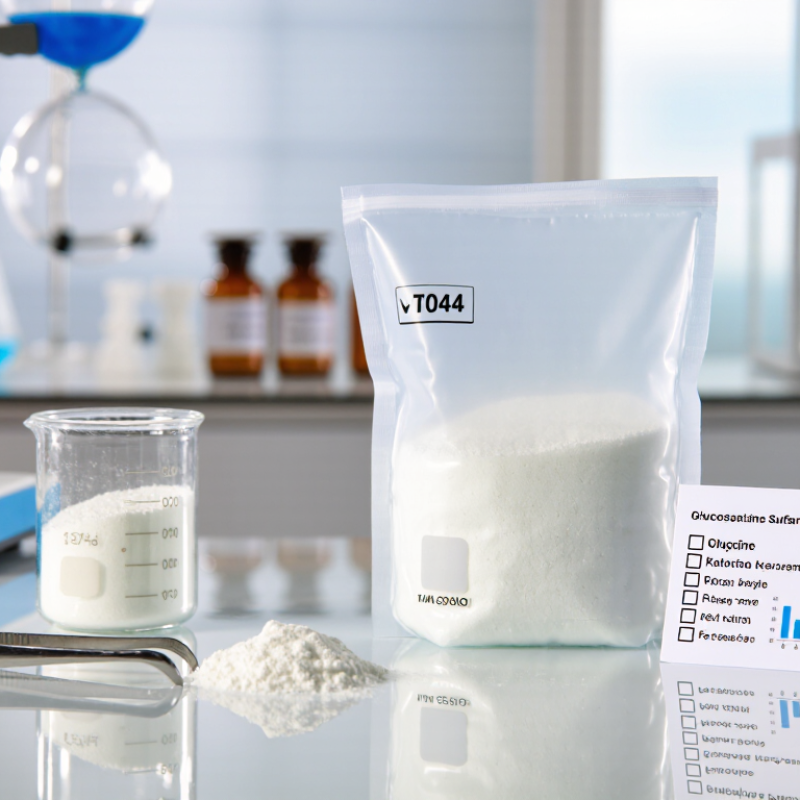
Glucosamine sulfate potassium chloride is a stabilized glucosamine salt, not ordinary glucosamine mixed with table salt. Its commercial form is commonly called Glucosamine Sulfate 2kcl. The molecule contains glucosamine sulfate and potassium chloride in a controlled ratio. This structure helps maintain stability during storage and transport. It is usually supplied as a white, free-flowing powder. It may be used in joint-health formulations, especially those targeting cartilage and connective-tissue support.
The World Health Organization estimated that 528 million people lived with osteoarthritis in 2019. That figure explains the continuing demand for glucosamine ingredients. However, market reports often combine hydrochloride, sulfate, and 2KCl products, making potassium-chloride-specific figures difficult to verify. This is an overlooked problem.
Quality assessment should examine assay, identity, sulfate content, potassium levels, water, heavy metals, microbial limits, and residual solvents. A reliable supplier should provide batch-specific certificates, traceability records, and recognized quality-system documentation. Testing matters more than a polished specification sheet.
Clinical evidence is not uniform. Some reviews report modest improvements in pain or function, while other guidelines find insufficient benefit for routine use. Formulation, dose, patient condition, and study design can change the result. Buyers should therefore avoid exaggerated claims. Practical sourcing also requires checking particle size, packaging protection, storage temperature, and stability data. I would not treat a low price as proof of efficiency. Occasionally, it signals incomplete testing.
China’s glucosamine sulfate potassium chloride supply base is concentrated in several manufacturing regions. Shandong and Jiangsu host large pharmaceutical ingredient facilities, supported by chemical engineering talent and established export ports. Zhejiang adds strong capabilities in contract production and quality testing. Guangdong is useful for trading, packaging, and faster access to overseas logistics.
Supplier types differ significantly. Integrated manufacturers control synthesis, crystallization, drying, and batch release. Specialized ingredient exporters usually source from several factories and provide documentation support. Smaller contract manufacturers may offer flexible minimum orders, but their validation systems require closer review. Grand View Research estimated the global glucosamine market at about USD 1.02 billion in 2023, with projected growth near 5.9% annually through 2030. This demand encourages capacity expansion, especially among producers serving dietary supplement and pharmaceutical markets.
Quality checks should examine assay, sulfate content, potassium chloride balance, residual solvents, microbial limits, and heavy metals. Request recent certificates, stability data, audit records, and traceability from raw material to finished batch. China’s manufacturing map is broad. Supplier directories can still be incomplete. That matters. A low price may reflect weaker documentation, not better efficiency. Independent laboratory verification remains valuable before approval.
The chart presents an indicative market-mapping index based on publicly visible Chinese pharmaceutical, nutraceutical, contract-manufacturing, and export-supplier activity. It is intended for initial sourcing research rather than audited market-share analysis.
Eastern and coastal provinces generally show stronger supplier visibility because of established pharmaceutical clusters, port access, chemical-processing infrastructure, and export logistics. API-focused manufacturers are typically the most relevant partners for bulk glucosamine sulfate potassium chloride sourcing.
Evaluating a supplier requires more than comparing quotations. Grand View Research estimates the global glucosamine market will continue growing through 2030, increasing pressure on manufacturers to prove consistency. Ask for a recent certificate of analysis, batch number, manufacturing date, and storage conditions. The assay should identify glucosamine sulfate and potassium chloride clearly, not only state “glucosamine.” Check sulfate, chloride, moisture, heavy metals, residual solvents, and microbiological limits. Small details matter.
Request samples from at least three production batches. Compare powder color, odor, solubility, and test results. A qualified supplier should explain its testing methods and provide laboratory accreditation evidence, such as ISO/IEC 17025 capability. The WHO Good Manufacturing Practices framework also emphasizes documented procedures, traceability, validated processes, and controlled changes. A polished certificate is not enough.
Audit the factory remotely or in person. Look for clean material flows, labeled drums, calibrated balances, and temperature records. Review the supplier’s export history, complaint handling, and recall procedure. UN Comtrade trade data can help verify whether declared export activity matches the supplier’s claims, although trade statistics may use broad product codes. I would not rely on one impressive audit. Supplier evaluation can still miss hidden subcontracting, and that deserves honest attention. Clear specifications, independent retesting, and a written quality agreement reduce that risk.
Chinese glucosamine sulfate potassium chloride suppliers should demonstrate more than competitive pricing. Reliable producers maintain documented specifications for assay, sulfate content, potassium, chloride, moisture, particle size, and appearance. These details help buyers compare materials consistently across batches. Clear records matter.
A practical supplier assessment begins with certification scope. ISO 9001 can indicate controlled quality processes, while GMP systems support manufacturing discipline and traceability. HACCP may strengthen risk control where applicable. Buyers should verify certificate numbers, issuing bodies, covered facilities, and expiry dates. A certificate alone proves little.
Product testing should include identity confirmation, assay measurement, heavy metal screening, microbiological examination, and residual solvent checks when relevant. Each certificate of analysis should match the lot number, production date, test methods, and release status. Independent laboratory testing adds useful confidence, especially before a large purchase. Keep retention samples. They are valuable during disputes or stability reviews.
Experienced buyers also inspect sampling procedures and storage conditions. A clean warehouse with sealed containers, humidity records, and pallet separation reveals daily discipline. However, supplier documents can contain gaps. Even a strong testing plan may fail if sampling is careless. I have found that small inconsistencies, such as different test methods between batches, deserve direct questions rather than quick rejection. That extra review often separates dependable suppliers from merely well-presented ones.
| Evaluation Dimension | Recommended Requirement | Applicable Standard or Method | Evidence to Request | Review Frequency |
|---|---|---|---|---|
| Product identity | The material should be identified as glucosamine sulfate potassium chloride, commonly supplied as glucosamine sulfate 2KCl. The chemical identity, salt form, and grade must be clearly stated. | Compendial monograph where applicable; supplier specification; FTIR or equivalent identity testing | Certificate of Analysis (CoA), product specification, safety data sheet, and representative identity spectrum | Each batch |
| Assay and potency | Set a documented assay range appropriate to the intended use. A common buyer specification is not less than 98.0% on the stated basis, but the acceptance limit must be agreed in the purchase specification. | Validated titration, ion chromatography, HPLC, or another stability-indicating method | Batch-specific assay result, method reference, chromatogram or calculation sheet, and test uncertainty where available | Each batch |
| Salt composition | Potassium, chloride, sulfate, and glucosamine content should be consistent with the declared salt form. Results should be reported with the calculation basis clearly defined. | Ion chromatography, ICP-OES or ICP-MS, and validated wet-chemical methods | Elemental and anion test results, calculation basis, reference standards, and laboratory approval | Each batch or according to a justified risk-based plan |
| Appearance and solubility | White to off-white powder or crystals, free from visible foreign matter, with a solubility profile suitable for the declared application. | Approved in-house specification and documented visual or solubility procedure | Inspection record, reference sample, and solubility test conditions | Each batch |
| Water content or loss on drying | The moisture limit should be defined because water content can affect assay calculations, flowability, caking, and storage stability. | Karl Fischer titration or validated loss-on-drying procedure | Result, test temperature and time, sample preparation details, and method validation or verification record | Each batch |
| pH of solution | A defined pH range should be specified for a stated concentration and solvent, since pH results are meaningful only under controlled test conditions. | Calibrated potentiometric pH measurement | Concentration, solvent, temperature, calibration records, and batch result | Each batch or periodic verification |
| Microbiological quality | Total aerobic microbial count, total yeast and mold count, and specified objectionable organisms should meet the limits required for the intended food, supplement, or pharmaceutical application. | USP <61>, USP <62>, Ph. Eur. 2.6.12 and 2.6.13, or applicable food microbiology methods | Microbiology CoA, sampling plan, laboratory accreditation details, and pathogen results | Each batch or validated risk-based schedule |
| Elemental impurities and heavy metals | Lead, arsenic, cadmium, and mercury should comply with the limits applicable to the destination market and the product category. Limits should not be assumed to be universal. | ICP-MS or ICP-OES; USP <232> and USP <233> may be relevant for pharmaceutical applications | Full elemental profile, detection limits, digestion procedure, and laboratory report | Each batch or documented risk-based plan |
| Residual solvents | Residual solvents should be controlled when solvents are used during manufacture, cleaning, extraction, or crystallization. The result should comply with the applicable solvent classification limits. | Headspace GC; ICH Q3C or equivalent regional requirements | Solvent-use declaration, GC report, method sensitivity, and compliance statement | Each batch when relevant, otherwise supported by process validation |
| Pesticides, mycotoxins, and contaminants | Testing should be based on raw-material origin, manufacturing inputs, contamination risk, and destination-market regulations. | LC-MS/MS, GC-MS/MS, or legally recognized contaminant methods | Risk assessment, annual screening report, and declaration of processing aids and allergens | At qualification and periodically thereafter |
| GMP manufacturing controls | Documented procedures should cover batch records, deviation control, change control, cleaning, calibration, complaints, CAPA, and traceability. | Applicable GMP requirements; PIC/S or national GMP framework where relevant | Current GMP certificate, audit report, quality manual summary, and batch-traceability example | Initial qualification and periodic audit |
| Food safety system | For food or dietary-supplement applications, the facility should operate a hazard-based food safety system with documented preventive controls. | HACCP principles; ISO 22000 or an equivalent recognized food-safety system | Valid certificate, scope of certification, hazard analysis summary, and audit status | Annual certificate review |
| Laboratory competence | Critical testing should be performed by a competent internal or independent laboratory using validated or verified methods. | ISO/IEC 17025 accreditation for relevant testing scope | Accreditation certificate, scope, proficiency-testing records, and analyst qualification records | Before approval and during periodic reassessment |
| Packaging and storage | Use sealed, food- or pharmaceutical-grade packaging as applicable. Protect the powder from moisture, excessive heat, and contamination. | Approved packaging specification; GDP or applicable storage requirements | Packaging material declaration, storage conditions, seal-integrity information, and shipping records | Each shipment and packaging change |
| Stability and shelf life | The assigned shelf life should be supported by real-time or accelerated stability data covering assay, appearance, moisture, microbiology, and other critical quality attributes. | ICH Q1A principles or an equivalent scientifically justified stability protocol | Stability summary, storage conditions, time points, retest period, and post-opening handling instructions | At product qualification and after significant process or packaging changes |
Selecting a Chinese supplier requires more than comparing prices. Confirm the supplier’s manufacturing experience, production capacity, and quality system before requesting a quotation. Ask for a recent certificate of analysis, including assay, sulfate content, potassium level, moisture, heavy metals, and microbiological results. The testing method should also be clearly stated.
Request a representative sample from the same production line used for your order. Check its appearance, solubility, packaging, and batch consistency. A reliable supplier should provide traceable batch numbers, storage conditions, shelf-life data, and clear export documentation. Video audits can help, but an independent factory inspection offers stronger evidence. It may feel slower. That delay can prevent expensive mistakes.
Tips: Compare at least three suppliers. Verify their business registration and manufacturing address. Discuss minimum order quantity, lead time, payment terms, and packaging before signing. Use moisture-resistant inner bags and confirm whether the outer cartons suit sea or air transport. Review destination-country requirements with a qualified compliance professional, because import rules and labeling standards vary. Do not rely on a polished website alone. One overlooked detail, such as unclear potassium chloride content or inconsistent testing, can affect the entire purchase decision.